The Organizer creating a community around independent game development
I’ve been a member of ICG for the last two years and LET ME TELL YOU it’s what’s kept me going after my indie dev dream. Not to sound super corny, but I have made some of the best friends for the rest of my life. -CJ Messam
The first thing one notices about Sebastian Galvez is the hair. Long and chaotically curled, it floats around their face with the same type of frenetic energy contained in the rest of their compact frame.
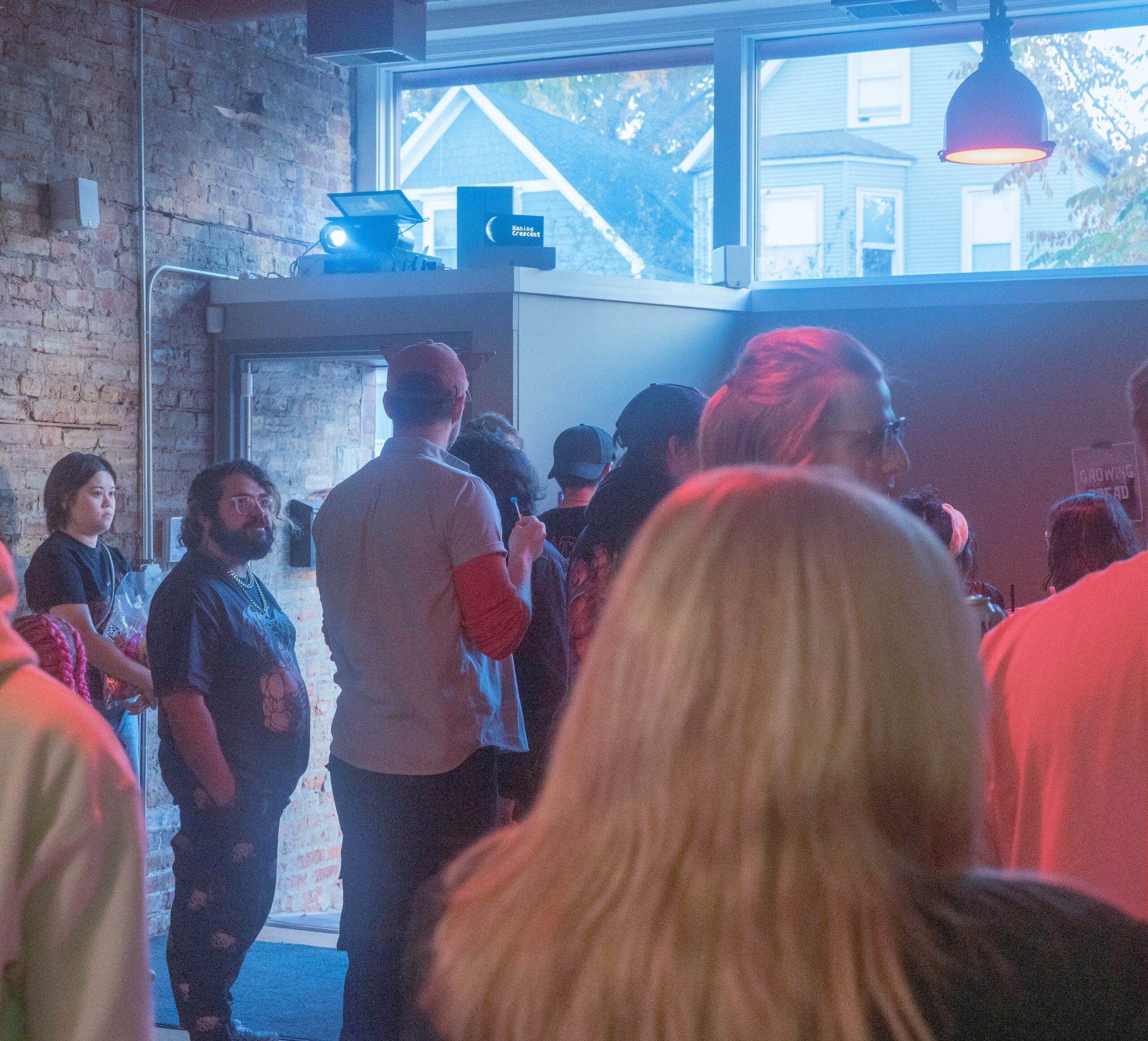
Galvez, who uses they/them pronouns, has grown a beard for the winter, and wears it around an easy smile. Their kind voice and jovial tone don’t exactly imply an ability to command a room, but almost 250 fledgling game developers hang on their every word.
These developers are attending the Chicago Indie Games Showcase, an event put on earlier this month with the goal of highlighting low-budget video games produced by hobbyists, students, and industry professionals in the city.
Participants submitted their games to the showcase without expectation of reward, instead hoping to find collaborators, industry connections and community, all things Galvez intends to provide.
“Development is a very draining thing to do,” Galvez said. “It’s solitary work, so we have to make an effort to meet each other and build a community around what we do.”
Galvez is one of the directors sitting on the board of Indie City Games, the nonprofit behind the showcase. ICG was formally incorporated in October 2023 and since then, Indie Games events have experienced massive growth in terms of attendance and interest from sponsors.
Through these events, ICG fosters a community of what Galvez describes as developer-artists making games-as-art. None of these developers have the support of massive corporations, but their relationships with each other more than make up for it.
One of these game developers is CJ Messam. He cites the nonprofit and its events as a major catalyst to his creative process. “After spending time with the community, I got the confidence to create the games and worlds I’d always dreamed of,” he said.
Messam also credits these relationships, fostered by ICG, as important to his continued success in the industry. He is months away from releasing his first game, and has submitted it to four festivals, where it has received attention from mainstream publishers.
Fostering relationships like Messam’s is something that Galvez stresses as being the most important part of what ICG does. “Intimate connections are massively important at this scale,” they said.
Video games on any scale are often viewed as successful by commercial metrics alone, something Galvez attributes to their inception as a commercial venture.
“Most other mediums had a chance to be art before they became products. Games were products first, and we’re trying to make them art,” Galvez said.
Galvez’s own games are almost anti-commercial in their process and goals. Galvez often works alone and describe their work as interactive art, stressing the unique nature of video games in that space.
“Games are the only interactive medium that requires audience participation to exist,” they said, flying into laser-focused movement to provide examples of this kind of art.
The question of whether video games can be art is one Galvez dismisses out of hand. In their view, art is anything a person makes that expresses their experience or worldview, games included.
This DIY, art-first spirit comes from Galvez’s adolescence, one spent going to underground punk and hardcore concerts. That past is written across their heavy steps and broad-shouldered gait, like someone expecting to enter a mosh pit at a moment’s notice.
Brashness like Galvez’s is refreshing, but often needs tempering, something provided by Jonah Lillioja, another director of ICG who describes himself as being raised as a visual artist and classical musician.
If Galvez brings can-do, underground spirit, Lillioja brings the exacting eye of an architect and a painter’s obsession with composition. In explaining his personal process, Lillioja said:
“Games are a combination of music, programmatic systems, art, foley and writing. My background has me exploring how those elements speak to one another and support the ultimate function of the game.”
The main method of game-making within their community is game jams. “Jams are like challenges, they have hard time limits and other criteria submissions have to meet,” Galvez explained.
ICG holds monthly game jam events in partnership with Night City, an art venue and game studio that hosts most of ICG’s in-person events. David Antognoli, the director of Night City, met Galvez in 2023 and has been happy with their relationship thus far.
“[Galvez] and I worked together to organize our Halloween show, Chicaghoul,” he said. “After that, the natural partnership between ICG as a community of developers and Night City as a space for platforming developers as local artists at in-person shows took off.”
These shows have one goal: to get more games out into the world. This goal is deceptively simple, and is only one the group meets, in Galvez’s view, because of the time limit imposed by the jams.
About the struggle to get developers to turn in finished projects, Galvez said: “The impulse in devs is always to make the game bigger and bigger forever. The time crunch helps them internalize limitations and work within them.”
This approach has worked. The nonprofit often exceeds its attendance goals and has managed to work with out-of-state organizations like the M+DEV conference in Madison, Wisconsin, and hand out cash prizes provided by corporate sponsors.
Now that the nonprofit has been officially incorporated for more than a year, they qualify for state and local grants, something Galvez and the board are paying close attention to going into 2025.
Looking forward, Lillioja wants ICG to continue to foster local artists and to grow as a force for change in an increasingly corporate world. “I want to prioritize the creation and appreciation of art at the local level and at the human scale,” he said.
Galvez is happy with the growth of ICG and takes pride in the community they’ve helped foster. About their work so far and their view of the future, Galvez said:
“I think we’ve done a great job convincing people that this exists and has legs and will stick around in the future. We’ve just got to keep moving as a community.”
Leave a Reply