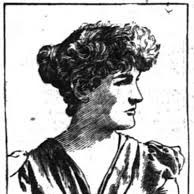
It was great for business. People were fascinated by this “you can believe me” character who was telling you things she had personally experienced. -Elizabeth Faue, Like a Comet Streaking Across the Sky: The Investigative Journalism of Eva Valesh
Once Nellie Bly opened the door for women in sensational investigative reporting, the practice spread to smaller regional newspapers across the entire country.

It is actually in Nellie’s native Midwest that the next most important hub of stunt reporting is born in 1888, in the immediate aftermath of the Blackwell’s exposé. In St. Paul Minnesota, Eva Valesh, a 22-year-old writer with a background in the labor movement goes undercover in a garment factory under the pseudonym Eva Gay.
Valesh found that female factory workers were largely single and were attempting to support themselves on criminally low wages. Labor politics were generally a realm men dominated, but by blending the sensationalism of stunt reporting with the “plight of the worker” narrative favored by labor agitators, Valesh and those like her were able to include women in the labor movement.
South of the Twin Cities, in Chicago, a writer using the nom de plume “Nell Nelson” (perhaps in reference to Ms. Bly) is hired by the publisher of the newly restructured Chicago Times to pose as a shop girl in factories and document the working conditions. Again, labor is the focus, something that would remain the case in the Midwest until the decline of stunt reporting in the early 1890s.
For the next three months (July to September 1888), Nelson documented her search for jobs — often fruitless — and the struggle of working women to obtain meager pay once their work was completed. She became so well-known that employers were on the lookout for her, casting her as a sort of boogeyman and forcing her to don disguises and switch her focus from the garment industry to the meatpacking industry.
Despite not coming from the same pro-labor background as Valesh, Nelson was similarly instrumental in shaping public opinion on working conditions and the unfair way that factory owners treated employees. Eric W. Liguori, in his exploration of Nelson’s work, says she was “instrumental in the formation of over ten social advocacy organizations spanning seven states, which worked to transform the way both women and children were treated in the workplace.”
Once she had exhausted the material Chicago could offer, Nelson too took off for the East Coast, following closely in Bly’s footsteps and landing in the same newsroom, continuing her “Slave Girls” series at the World.
Sources
HEATH, BEN, ELIZABETH FAUE, and BROOKE KROEGER. 2023. Like a Comet Streaking across the Sky: The Investigative Journalism of Eva Valesh. KFAI Twin Cities.
LIGUORI, ERIC W. “Nell Nelson and The Chicago Times ‘City Slave Girls’ Series.” Journal of Management History. 18, no. 1 (2012): 61–81.
PEKO, SAMANTHA, and MICHAEL S. SWEENEY. 2017. “Nell Nelson’s Undercover Reporting.” American Journalism 34 (4): 448–69.
TODD, KIM. 2023. Sensational: The Hidden History of America’s Girl Stunt Reporters. Harper Perennial.
Leave a Reply