What Past collapses of fandom spaces can tell us about the current state of social media
On Sunday, January 19, 2025, the American Agora will go dark.
That is, unless nine middle-aged (some who have long ago passed the threshold gating “elderly”) lawyers in robes decide to fly in the face of the whole concept of national security penned post-9/11 and save an app they do not appear to understand. I’m of course talking about TikTok.
The TikTok ban is interesting in part because it echoes the bans of previous, similar sites. Tumblr’s so-called “porn ban” happened in the wake of legislation as well, while LiveJournal’s population left in droves after the website removed users who had posted explicit or kink content. Despite the previous two bans concerning content and this most recent attempt threatening the removal of a whole platform, there is a line to be drawn between these events, and I have not seen anyone with the correct type of brain rot to do so. The task then falls to me.
The Supreme Court
There have been periods of history when the United States Supreme Court has been more interested in granting rights than taking them away. The Constitution is vague on purpose and has been utilized to do such things as decriminalize sodomy (Lawrence v. Texas) and unilaterally recognize interracial marriages (Loving v. Virginia). The current iteration of the Roberts court is not one of these periods.
Just in the past five years, the current court has taken away federal abortion protections (Dobbs v. Jackson Women’s Health Organization), paved the way for municipalities to criminalize homelessness (City of Grant’s Pass v. Johnson), and seem poised to reevaluate the legitimacy of same-sex marriages and possibly interracial marriages. The whole country (or at least those posting online) are sitting on tenterhooks, waiting for the next spate of rights to be taken from them by, once again, (largely) boomers in robes.
If you’re somehow unaware of how this relates to TikTok, I’ll connect the dots. In April 2024, the House of Representatives passed a foreign spending bill that provides funding to, among other things, Ukraine, the Navy, agencies attempting to stop the trafficking of fentanyl, and, oh yeah, it bans TikTok. The division in question (H.R. 815, Division H) takes its name and wording from a March bill and reads, in part:
“This division prohibits distributing, maintaining, updating, or providing internet hosting services for a foreign adversary controlled application (e.g., TikTok). Under the division, a foreign adversary controlled application is an application directly or indirectly operated by (1) ByteDance, Ltd., TikTok, their subsidiaries, successors, related entities they control, or entities controlled by a foreign adversary country.”
Oddly specific and uniquely devastating to those Americans that have found community, revenue, or entertainment through this “adversary controlled application.” Here’s how the Court comes into this. TikTok’s lawyers mounted unsuccessful lower court appeals on constitutional grounds and then filed writ with the Supreme Court. In December, the Court agreed to hear both the suit brought by TikTok (TikTok v. Garland) and a similar case brought against the government by some users of the app.
The Court may rule on the constitutionality of such a ban prior to it taking effect or they may grant an administrative stay to give themselves more time to think. (As of January 17, the Court has decided against TikTok, though outgoing President Joe Biden has signaled his reluctance to enforce the ban that he himself signed into law.) Groups like the ACLU are characteristically adamant that this ban poses unique threats to free speech, and the government appears to be pearl clutching once again about overblown threats to national security.
In short, it’s a mess.
LiveJournal
Now that we’ve taken a look at the stakes, let’s go back in time to 2007 and consider the past. In May of that year, LiveJournal users woke up to find their friends list full of names that had been struck through. Many seemingly innocent journals, gone overnight.
So, what happened?
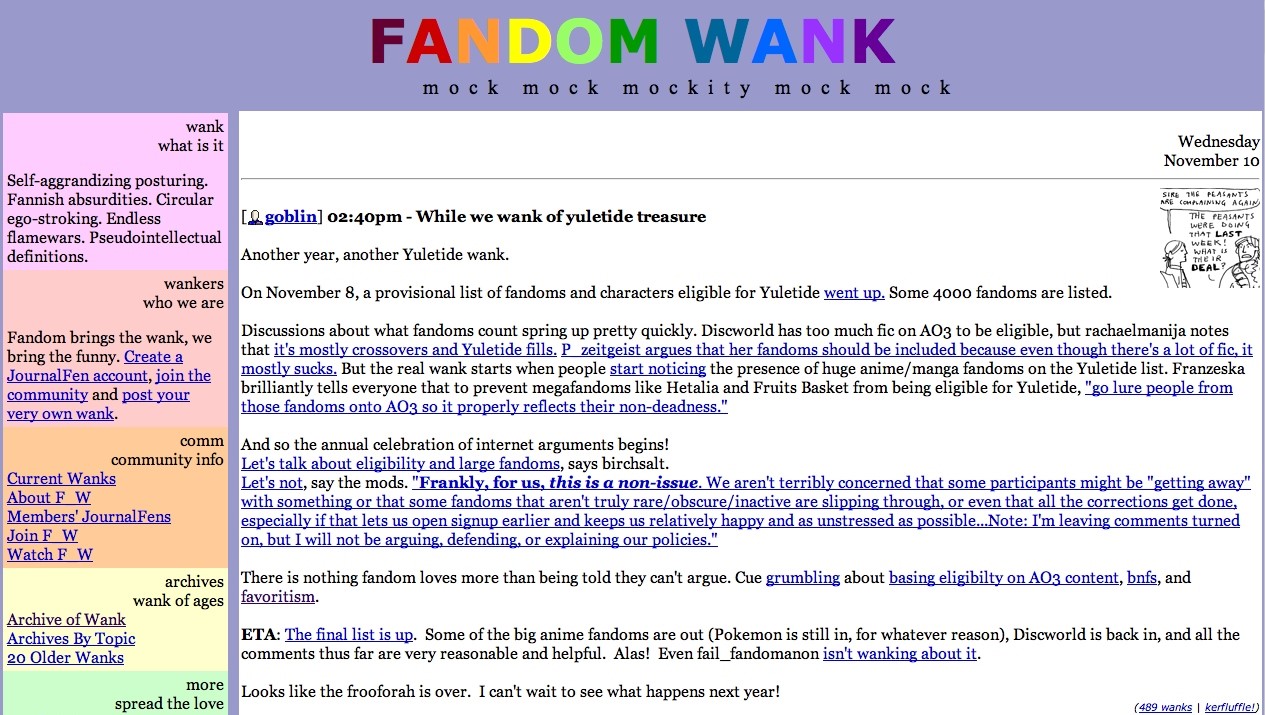
LiveJournal was a personal blogging platform popular with fandom types and home to one of my favorite early 2000s internet scandals, the Ms.Scribe debacle. Much of the content was, to put it bluntly, porn.
That’s neither a condemnation nor entirely accurate, but I’m going to stand on that assessment. Fandom types at that time (and today) are proud of their ability to produce porn, and that’s something one has to respect them for.
The porn is important for many reasons, but in this case, it led to the mass suspension by Six Apart (the company who owned LiveJournal) of many journals that interacted with or professed interest in NSFW content.
Now, adult content was never explicitly banned on LiveJournal, and thus, it thrived. However, possibly in response to reports from an organization named “Warriors for Innocence” that professed to be hunting pedophiles and possibly in response to pressure from advertisers, Six Apart cracked down.
Accounts that were suspended had publicly listed interests ranging from cocaine to BDSM to incest (those interested in election fraud, however, were spared). One of Six Apart’s first statements on the matter equated the listing of these interests to solicitation of the items or materials they concerned, which seemed a stretch to most users.
The main hub of suspended journals was a community called “Pornish Pixies,” which was made up of Harry Potter smut. Considering the ages of many characters in that series and the opinion of Six Apart that interest in pornographic material is equivalent to criminal solicitation of that material; these journals were therefore breaking both LiveJournal’s terms of service and the law.
So, in order to avoid what they saw as legal liability, they suspended some enjoyers of Drarry smut (as well as some communities for survivors of rape and sexual assault), made several poorly received statements on the matter, and eventually walked most of it back.
But it was too late.
Many creators and enjoyers of fanworks had paid for lifetime memberships only to see their accounts suspended. Employees of Six Apart appeared to be mocking them. They wanted their money back.
This event (later dubbed Strikethrough in reference to the suspensions) and the controversy that followed (Boldthrough, which consisted of more permanent suspensions) would lead to the first mass exodus of users from the site. This migration coincided with the creation of fan-run spaces like Dreamwidth and Archive of Our Own, and serves as a chilling example for other platforms:
There are many things you can afford to lose, but the trust of your users isn’t one of them.
Tumblr
Speaking of platforms that lost the trust of their userbase: let’s talk about Tumblr circa-2018.
Much like LiveJournal, Tumblr was a space where fandom-types were able to express themselves in ways both benign and pornographic. There was a vibe on the site of unapologetic weirdness, something that both repulsed and drew in users in about equal numbers.
Tumblr was special.
Given my age, it was where I first cut my teeth consuming fanworks. I was never really there for the porn, but I knew many other queer young people that saw themselves reflected in the NSFW material. For those users, the porn on Tumblr was a kind of sex-ed and an escape from the heterosexual gaze of mainstream pornography. To see cropped gifs of gay porn being posted in the Destiel tag was to see yourself.
The site became a haven for independent sex workers and acted as a landing point for many LiveJournal refugees upset with the content moderation there in the wake of Strikethrough. In a way, porn, fandom-centered or otherwise, built Tumblr.
What I consider to be the heyday of the platform was 2012 to 2016. It was possible, in those days, to scroll forever and never reach the end of your dashboard. Content was tailored to you not by an algorithm, but by the parameters you set.
Sure, it was considered unusable without xKit, and sure, people were constantly getting into silly, drawn-out slapfights about why “your fave was problematic,” but we were free.
That is, until 2018.
The government passed a package they called (in their infinite creativity) FOSTA-SESTA, or the “Allow States and Victims to Fight Online Sex Trafficking Act” and “Stop Enabling Sex Traffickers Act.” This piece of legislation is often cited as the one thing that led to the Tumblr porn ban, but was it really?
Well, kind of. Section 230 of the Communications Decency Act of 1996 gives a safe harbor to platforms, allowing them to avoid legal liability if their users post content that violates either platform terms of service or the law. In the eyes of the federal government, that provision has created a loophole that online sex traffickers exploit in order to facilitate solicitation and target children, among other things.
This legislation was devastating to websites like Backpage and the personal section of Craigslist (which would both shut down in the wake of its passing) but was not immediately applied to sites like Pornhub or Tumblr. Instead, it was Apple that created the porn ban.
Perhaps as a proactive reaction to FOSTA-SESTA, perhaps in a bid to please advertisers, Apple removed Tumblr from the App Store, claiming it hosted child pornography. Whether or not that accusation holds water has been lost to time, but in any case, Tumblr banned explicit content and was subsequently restored to the App Store.
This did not go over well.
Not only was the ban poorly-implemented (we all remember when they banned the tubby custard machine), but it was ruinous to the careers of sex workers and those who produced NSFW fanart. Many of them chose Tumblr because of the anonymity the site afforded them and the sex-positive, anything goes atmosphere of the site at its peak. Where were they to go?
Some posited Twitter (though, it was “Full of Nazis“) and others who had migrated from LiveJournal suggested Dreamwidth. Unfortunately, neither took. Many Tumblr users chose to leave the site, and as a result, stopped producing the kind of content that had made them popular, happy, or horny on it.
There is no place on the internet like Tumblr. I’m still on it, and many like me reaffirm their allegiance to their “favorite hellsite” every time the website gets sold or makes an unpopular policy change. It’s a place full of adaptable people, willing to stomach discomfort if it means keeping their connection to a place that had fostered their creativity, helped them discover their identity, or provided them content about their niche interests. Despite that, no user of Tumblr would claim to trust (or even like) the staff of the website they refuse to stop using.
Although many Tumblr veterans remain, there have been several marked declines in user activity. First was the aforementioned “nipple ban” in 2018, then was the mass-deletion of tags (including seemingly innocuous ones such as #girl) in 2021, once again in response to pressure from Apple.
The website persists, but it does not thrive. Such is the lot of fandom spaces.
Platform migration and the death of TikTok
What does this all have to do with TikTok? Once again, I’ll connect the dots. And this time, it’s not about porn. I promise.
LiveJournal acted as a mass forum, allowing users to interact with their friends and strangers alike, follow trends, create fandom content, and even get into petty arguments. I see some of that in TikTok. People curated their own experience on both sites, though TikTok used an algorithm to make that curation easier. The culture was both informal and full of microcelebrities that dominated the conversations. Anyone could become famous (or infamous). Not everyone would.
When Strikethrough happened, many users left the site in favor of destinations like Tumblr and AO3. In response, Six Apart apologized, but to who? There was no one left. In desperation, they sold the site to a Russian company, who upkeeps it to this day. Ironically, per the government’s definition, LiveJournal may then be considered an “adversary controlled application,” but no Americans use it, so perhaps it’s not worth making the comparison.
LiveJournal collapsed because its owners were spooked by advocate groups and the possibility of lost revenue into betraying their userbase.
The culture of LiveJournal moved (almost) in its entirety to Tumblr, where it grew and changed to fit the new format. Conversation was similarly informal, and anyone could add their thoughts to yours simply by reblogging your post. Your dash may be full of your friends, but it was often full of content made by complete strangers. Everyone was anonymous, and you had to trust they were who they said they were.
Tumblr fostered a culture of unfettered creativity and unapologetic weirdness. I see a lot of that in TikTok as well. Just this month, I’ve seen many TikTok videos I can clearly envision as Tumblr posts, and the informal conversation style that characterized LiveJournal and Tumblr is present there too. Anyone can post their thoughts and get a conversation started. Anyone can add onto it by stitching the video.
Tumblr collapsed because tech companies got scared by legislation into cracking down on adult content, and Tumblr rolled over and complied, once again betraying their userbase.
When LiveJournal collapsed, their community chose Tumblr. When Tumblr collapsed, their userbase scattered, but never permanently settled. When TikTok collapses, who knows what will happen? There are many creators who are desperately trying to migrate their content to sites not built for or welcoming of it. Others are content with the knowledge their work will not be transferable. They had a good run.
One way that the collapse of TikTok differs from those of Tumblr and LiveJournal is the scope of TikTok’s ban includes the entire platform, rather than specific content that some people find objectionable. Another is that it is collapsing not because of mismanagement, but because the government is forcing it to. Even if they manage to sell to an American company, the app will never be the same as it was. Many users will never trust an American owner, considering they would rather learn Mandarin than take refuge in any platform owned by Mark Zuckerberg.
As the proverbial city burns, users are dancing in the ashes, celebrating their willingness to go down on the USS TikTok.
It’s their very own favorite hellsite, and they’ll stay until Congress kicks them out.
Leave a Reply