One-Cannon Salutation
The first thing of note at the McFadden-Ross house is a sign with a cannon on it. The sign, as well as the house, sit off the main thoroughfare of Dearborn, Michigan behind an area the curatorial staff of the town’s historical museum fondly calls “Lizzie’s field,” after the woman who willed the house to the museum.
Mason Christensen, the resident archivist – though he later said that he wears many other hats – explained the house’s past as gunpowder storage for the Dearborn arsenal. The cannon is apt, then.
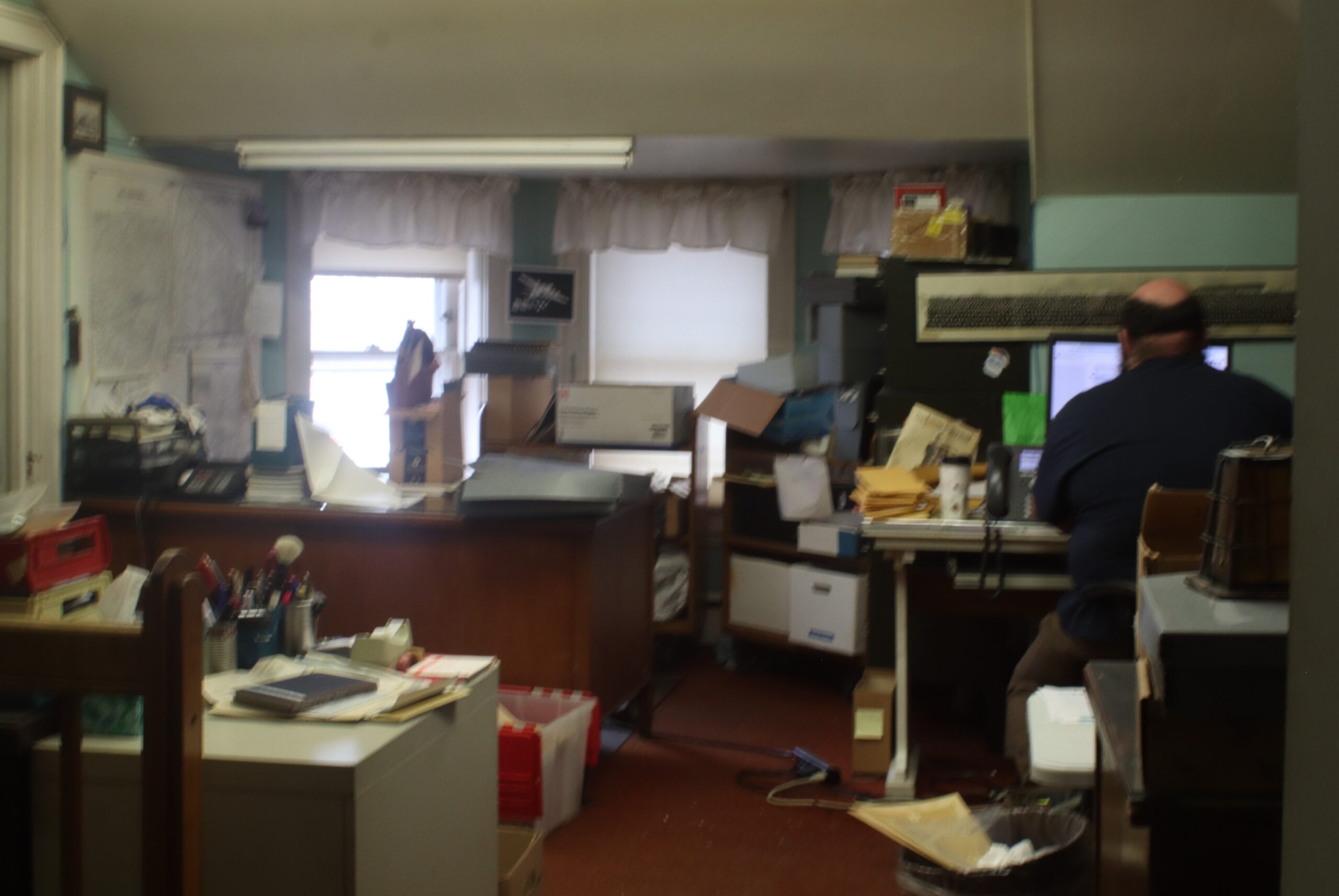
A stoic, bearded man in round glasses, he led the way up a set of steep stairs to a sloping room that serves as both his office and the city’s archives.
“It’s most comfortable up here,” he said. Non-archivists may not agree, but he took a seat at the only desk not covered by boxes, yellowing newspapers, and objects hard to make out at a first glance.
“I grew up in the Lansing area,” he began, explaining his personal history slowly and deliberately.
Christensen went to school out of state, but says he returned because, “you tend to get more bites on job applications in state, where you’re from.” Despite the fact he’s not a lifelong resident of the city like chief curator Jack Tate, Christensen confidently described himself as one of the most knowledgeable people about local history in the city.
He dumbed that statement down slightly: “I’m very much a local history nerd.” It’s hard not to believe him, sitting as he was among file cabinets and historical documents in a T-shirt that read “say YES to history!”
Local history museums have made up the majority of Christensen’s career post-grad. First in Charlotte, Michigan, a small town southwest of his native Lansing. There, he said he learned most of his initial skills in social media management, the topic that brought him and I together on that foggy morning.
Changes in the Social Media Age
The last time I had been to the Dearborn Historical Museum was when I was seven years old, before Christensen was hired to take over the accounts and before museums had social media presences in general. That’s not the case anymore.
Today, Christensen regularly posts historical images and videos on the museum’s Facebook and Instagram pages, captioned with context and fun facts.
“Facebook is king,” Christensen said. “In the old days, museums would promote themselves via press releases and newspapers. All those things have kind of fallen apart, basically. What museums are left with for channels is social media. It’s really all they have.”
He is not unique in either opinion or practice. Liz Becker, a recent MLIS graduate with a background in museum studies, agreed with him and contextualized the landscape for local historical museums overall.
“Most small and local museums place their social media presence squarely in the space of cross posting the same content to Facebook and Instagram. That’s where they see the majority of their followers and engagement,” they said. “The older crowd uses Facebook, and the younger crowd uses Instagram. It’s like a two birds, one stone thing.”
Despite my interest in the social media presence of the museum, Christensen seemed to find the topic somewhat banal. I will come to learn that he speaks more quickly when he’s excited, and at that point, he was sedate. I changed tack and asked about the shake-up in museum staff in 2012.
“This museum had a lot of issues getting into the 2000s,” he said, words flowing faster. “They [the past curators] were hoarders, is the best way to put it.”
This was an understatement. Before Tate’s appointment as curator in 2012, the museum was so mismanaged, they lost city funding. It took Tate four years to hire Christensen, but in that time, he returned artifacts to places like Louisville, Kentucky and even Minnesota.
“It’s not our job to collect the history of other places,” Tate said.
Christensen agreed: “It wasn’t really a functional museum. I think they used the Northwest Territory as part of their collecting scope, which if you know what the Northwest Territory is, that’s basically everywhere from Ohio to Minnesota.”
The archive, too, was hanging by a thread when Christensen came along, being run by volunteers a few days a week. He once again referenced the chaos of the previous administration, then sighed and said that when he was hired, nothing had been done to upkeep the archives.
“People in the community don’t know we’re here,” Christensen said. “It’s still a battle we’re fighting, obviously.”
Finally Addressing Henry Ford
Another battle is one between the Henry Ford Museum of American Innovation and the Dearborn Historical Museum, the city’s two historical attractions.
On one side, there’s the large, shiny Henry Ford Museum, complete with the Rosa Parks bus and a replica of Charles Lindbergh’s plane. On the other side and a mile away, there stands two 19th century brick buildings, once part of the Dearborn Arsenal, now the headquarters of the Dearborn Historical Museum.
Each person I spoke to seemed to have an opinion on the relationship between the two museums.
Becker rolled their eyes and chuckled. “The Henry Ford Museum is upholding a particular narrative of Dearborn that has a lot of silences in it. It erases a lot of people who were there and made an impact,” they said. “The average Dearborn resident might not see themselves in Henry Ford, but they can see themself in the collection at the Dearborn Historical Museum.”
Tate disputed the very idea that there is a competition at all. “It’s not a competition, museums are partners,” Tate said. “They [The Henry Ford Museum] have been a tremendous help to us, we wouldn’t be what we are without them.”
Christensen has generally been in lockstep with his chief curator each time he’s come up, but he laughed this time. “Do you ever see any Dearborn history at the Henry Ford Museum?” he asked in a way I could sense was rhetorical. My answer in the negative didn’t seem to matter, as he barreled on:
“That’s why we exist. We are the local History Museum. We’re actually here to talk about Ford workers, to talk about the businesses that are supporting the Ford plants, things like that. There’s a lot of support history that is not covered at the Ford Museum or even in the Ford Archives. And that is really our mission.”
Christensen’s passion for local history reared its head particularly aggressively during this line of questioning, something that reinforced the fact that despite his outsider status, Christensen has become devoted to the City of Dearborn and its scrappy local history museum.
Is it Out of Character to Look to the Future?
“It’s fulfilling being here. Honestly, it’s like, it’s entertaining here,” he said of the city. He went on to discuss the food scene – in his estimation, better than Lansing’s – and provided appropriate historical context for everything from pepperoni rolls to modern-day Ramadan celebrations. Then, like all things with Christensen, it returned to his work.
“It [Dearborn] is a very dynamic city,” he began. “Even just since I’ve been living here, I’ve recognized that there’s changes even since then, and we’re trying to actively collect things. There aren’t many museums on our particular size level that are trying to actively collect as much as we are.”
But why is that? Christensen believes that it has to do with Dearborn’s growing population, something that sets it apart from the rest of the state, and the changing demographics that come along with that.
“If your demographics aren’t really changing that much, what reason do you have to collect a bunch of new things?” he said. “Here, we know the demographics are changing.”
It is true that Dearborn’s population is trending younger and the population of immigrant groups from areas like Yemen are increasing, though the changes are gradual enough that a resident not as tuned in as Christensen could be forgiven for not noticing.
“Do you want to know the perfect world vision of what this museum could be?” he asked me toward the end of our time together.
“We talk about this all the time, me and my co-workers,” he continued. “In a perfect world where we’re given an unlimited budget, we’d love to reconstruct some of the old Detroit Arsenal buildings.”
Military history may not be part of the popular image of Dearborn, the so-called “Hometown of Henry Ford,” but it remains important to Christensen’s work and the museum’s more holistic view of its home city.
“There’s a lot of focus here in trying to teach local kids what it was like in an era before all of Metro Detroit was basically a concrete jungle,” Christensen said with a wave of his hands. “We understand Melvindale, Dearborn Heights and other places, they have historical societies, but they don’t have museums, so we’d like to be more of a regional history center. There’s a wider story that we’d like to be able to tell that goes beyond the immediate Dearborn city boundaries.”
Leave a Reply