
This column was originally published in Back Alley Games Issue 22, Spring 2026. More of my writing and thoughts about music can be found within their pages and on their website.
Below every YouTube upload of the May 1997 performance of Fleetwood Mac’s “Silver Springs,” there are endless comments discussing the stage behavior of one Stephanie Nicks and her ex-everything, Lindsey Buckingham.
Some cheer her for “cursing his entire life.” Others point out that they both look “heartbroken and crushed” by the then 20-year-old dissolution of their relationship. Still more posit theories about reconciliation and joke that Mick Fleetwood appears to be high or otherwise drumming through the absolute massacre occurring downstage of him.
And from certain angles, I can see all of their points. Nicks does glare daggers at Buckingham, especially as she sings about his inability to “get away from the sound of the woman who love[d] him,” and Fleetwood is absolutely blissed out on the power of percussion (though not more than usual).
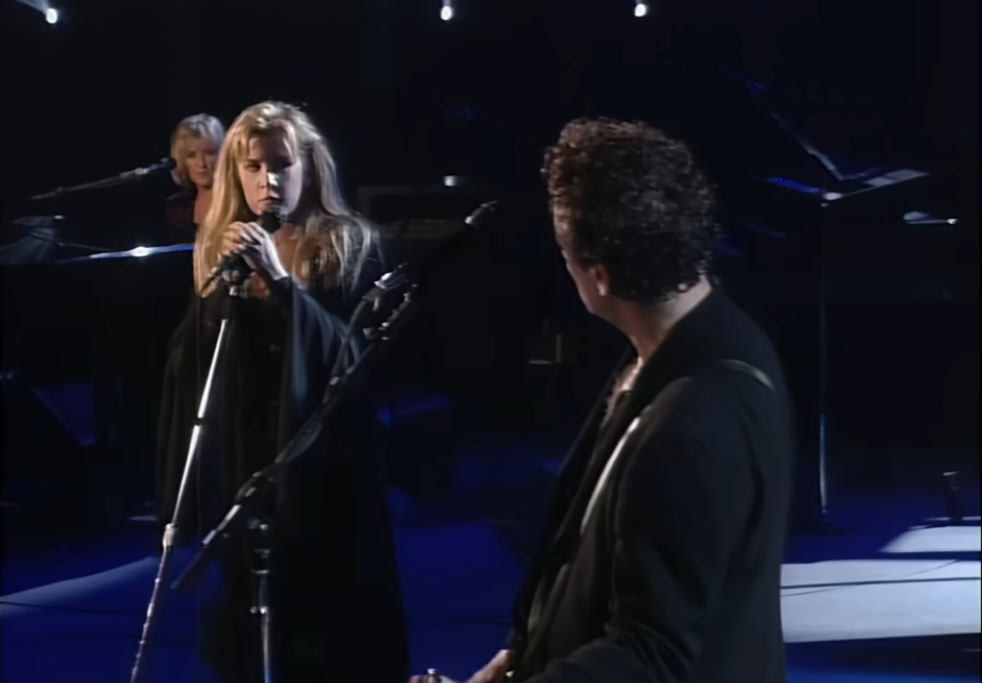
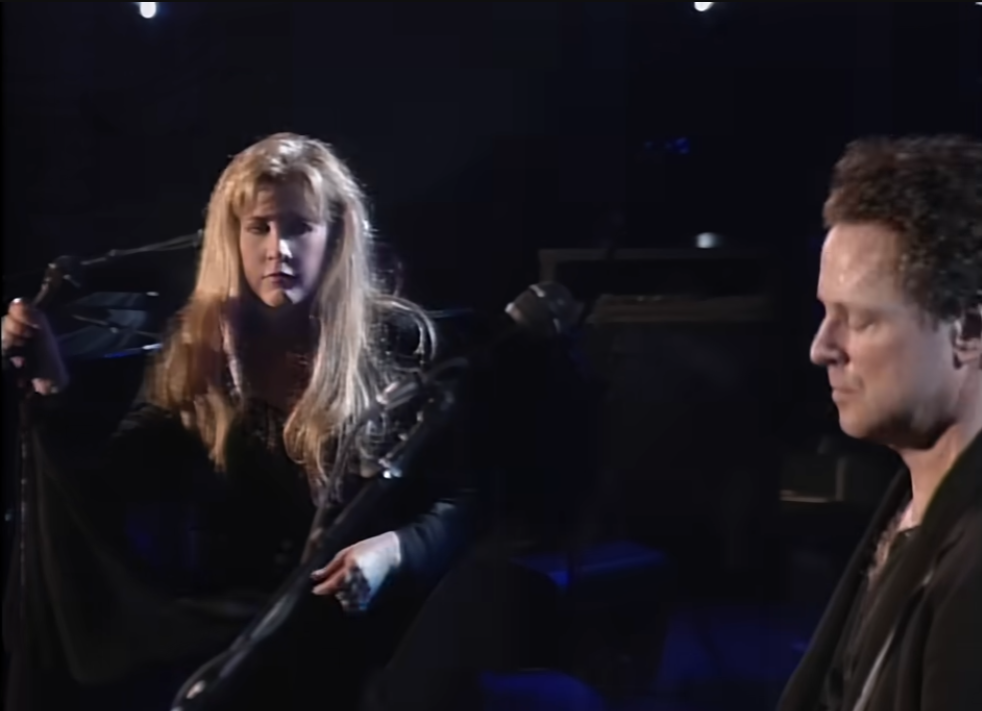
The hatred and heartbreak of Buckingham/Nicks, 1997 (From Fleetwood Mac on YouTube)
Some see Nicks as angry, seconds away from pouncing on her ex and stabbing him with her boot, and others as heartbroken, reminiscing on the failings of her long-ago romance with the co-worker standing next to her. There is no consensus as to whether these feelings are contradictory, whether they are mutually exclusive, or whether Buckingham Nicks will ever reconcile like that.
What Stevie really feels doesn’t matter, though. Only our perception does.
Aristotle coined the term catharsis in the book “Poetics,” describing it as the purging of negative emotions through the viewing of tragic art. He is thought to have created the term to discuss how interaction with the arts can create a more morally upright populace.
After all, the term is linked to the Greek medical theory of “katharsis,” or purging, often of an illness. When an audience is forced to confront tragedy, they experience the same negative feelings as the tragic hero and thus are purged of those same feelings in their real lives once they leave the theater.
Once purged, those former audience members would be rational and less prone to outbursts of negative emotions such as fear, pity, and anger. Tragedies, then, are the path to a better world.
On that last point, I am willing to agree, though I would like to present a more charitable interpretation of Aristotle’s concept of catharsis.
Fear, pity, and other emotions aroused by tragic or horrific art are deeply human and thus cannot be fully repressed. However, experiencing them in an environment that carries no real stakes – a safe space, if you will – allows us to examine the feelings enough to learn from them.
Few audience members that have seen a production of “Oedipus Rex” would want to be the titular king, but most are able to take their feelings of pity, horror, or disgust at his tale and apply them to the (hopefully less incestuous) events of their own life.
This displacement of feeling is why great art has the ability to resonate with so many people and may go far toward explaining why so many are sure that Stevie Nicks felt a certain way about Lindsey Buckingham in May 1997.
In fact, breakup songs are one of the best vessels for exploring the feeling of catharsis, even more so when the subject of that heartbreak (or ire, or ambivalence) is sharing the stage with the author.
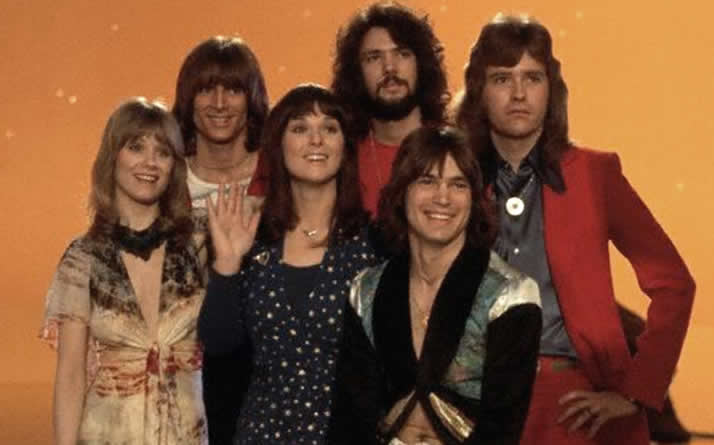

Heart with the Fishers and Heart without, 1977 and 1980 (Photos from Epic Records)
The concept even works for stage relationships that have broken down entirely. Besides Fleetwood Mac, who were constantly breaking and making up, another ‘70s band may hold the title for “most incestuous,” namely Heart.
Led by the Wilson sisters – Ann as lead songwriter and vocalist, Nancy as rhythm guitarist – and supported by the Fisher brothers – Roger on lead guitar and Mike, ex-drummer and manager – the band is perhaps most famous for “Barracuda,” an aggressive, driving rock song about a persistent creep.
Ann dated Mike and Nancy dated Roger. The highs were high, with Ann penning all-time banger “Magic Man” about Mike, but the lows were lower.
According to the Wilson sisters, the band unanimously voted to kick Roger out of Heart following their 1978 album Dog & Butterfly and his breakup with Nancy, and Mike was quick to follow, either stepping down as manager shortly before or shortly after the release of follow-up record Bébé le Strange, aka my favorite Heart album.
The band released Bébé le Strange on Valentine’s Day, 1980 as a bit of what Ann describes in her memoir as “gallows humor.”
On that record is the song “Break,” which is both an SEO nightmare and a fantastic example of the new hardened direction of Heart under the full control of the Wilsons, devoid of the softer, folk elements of previous records.
Ann sings that “there ain’t no more magic, man,” and declares that she has “no more respect for the big man” over Nancy’s lightning-fast strumming.
That indictment is even damning when read as plain text.
When confronted with the raw power and anger of a voice like Ann Wilson, one can’t help but feel pity for the poor soul she’s talking to. Catharsis in this case, then, is taking on the pain of Mike Fisher and every other man stupid enough to piss off a woman.
Another YouTube commenter puts it best under the song’s music video, saying “This song’s like being beat up for three minutes. GOOD STUFF.”
The audience chooses to take the vicarious beating as a way to atone for all the harm they’ve caused and all the harm they’ve yet to cause. Being beat up by Ann Wilson is “good stuff” because it reminds us that when we choose to hurt others, they can always hit back.
Another case brings us, as all things do, to Olympia, Washington. My beloved Sleater-Kinney is another band that features a powerful voice and a wickedly talented guitarist that once dated each other.
Corin Tucker and Carrie Brownstein, were, until right before the release of their third album, secretly dating each other. The lead single of that album, “One More Hour,” is an absolute odyssey of a song. From Tucker’s wailing lament and Brownstein’s monotone placations to newcomer Janet Weiss’s steadfast percussion – literally drumming her way through an emotional minefield.

Carrie Brownstein and Corin Tucker, 1996 (The Guardian, c/o Carrie Brownstein)
The song is about Tucker and Brownstein’s breakup, if you hadn’t already guessed.
I’ve listened to this song more than any other I’ve mentioned so far. I’ve mimicked Brownstein’s vocals, whiny and nasally; I’ve screamed Tucker’s parts to myself in the car; I’ve thought about the nuances of love, relationships, breakups and continuing to make art with a person despite it all.
It’s a powerful song.
But the best moment is early in the song, between the first chorus and second verse. The chorus ends with Brownstein alone, declaring that she “never wanted to let [the relationship] go,” then Tucker begins again, asking a seemingly rhetorical question: “If you could talk, what would you say?” An odd thing to say to a person who just finished speaking.
This is the best moment of the song not because it’s a little bewildering, but because it reveals the heart of the whole thing. Carrie Brownstein and Corin Tucker are not bitter exes. They are not separated by time, distance, or ambivalence. Their creative partnership is the force that has and will continue to sustain their lives and careers.
If Tucker wants to know what Brownstein has to say about anything, she can just ask. But does the answer matter?
No. Any answer that either could give would not change the way the other is feeling. The feelings aren’t rational; they’re from a much deeper and harder to access part of the human psyche. Sometimes, there are no clean breaks. Sometimes a person is so important to you, you can’t let them go, even if that makes the hurt worse.

Carrie Brownstein and Corin Tucker, 2019 (Image by Jonny Cournoyer)
According to Brownstein, almost every song on Dig Me Out is about her, and while the two may have broken up almost 30 years ago, they haven’t subjected the band to the same fate.
Instead of letting a breakup album force them to grow apart, Tucker and Brownstein let it be the thing that made them grow together.
Catharsis, then, is found in experiencing pain, then letting it lie. The pain isn’t a conversation, it can’t be placated, and the only solution sometimes is to put it all out there, messy and inexplicable, and then move forward.
Finally, I return us home to Chicago for a look at underrated alternative rock heroes, Veruca Salt. Made up mainly of guitarist-vocalists Nina Gordon, a dour blonde, and Louise Post, a smirking brunette, the band produced a few fantastic records in the 1990s before splitting up.

Nina Gordon, 1994 (From Veruca Salt on Facebook)

Louise Post, 1995 (From Veruca Salt on Facebook)
Post got the band’s trademark, Gordon got material for a solo record that is mostly about the breakdown of her personal relationship with Post.
In an effort to avoid a lawsuit, I will say that the two were very close friends. Songwriting partners and studio mates. Post described them in 2015 as “mirrors” and called Gordon her “inspiration.”
Once the two split, an explosive event they still refuse to talk about, Gordon put out a mellow, singer-songwriter album, Tonight and the Rest of My Life. The guitars are still there, to be sure, but it’s bouncier. More Mazzy Star than The Breeders.
Post, always the Seether, aimed for a more hard rock sound. She seemed a little angrier, a little more broken up over the whole thing.
The most interesting part of the split, though (besides the mysterious circumstances), is the song “Black and Blonde.” Before 2015, it was just the closing track to Gordon’s first solo record.
Beginning dreamy and bittersweet, it quickly gives way to abrupt, distorted guitars more indicative of Post’s influence. Gordon demands that “somebody tell [her] what the hell is going on” after claiming that someone had beat her “black and blonde.”
In the chorus, there are calls for someone to “save the little child,” and much talk of drowning, then the outro reintroduces longer, gentler guitar melodies interspersed with lyrics about hearing the ocean.
By the end, the listener is left with the feeling that Gordon has made it through the turbulent, “oh god I’m drowning” portion of the breakup and has made it to the shore. Then Veruca Salt got the band back together.

Nina Gordon and Louise Post, 2015 (From Veruca Salt on Facebook)
After marriages, children, and seeing Mazzy Star perform at Coachella, the two were ready to give it another try. The resulting album, Ghost Notes, is a personal favorite, though it wasn’t particularly well received.
The second track on Ghost Notes is, once again, “Black and Blonde,” though it’s gone through some significant changes since the last time we heard it.
In rewriting the song, the two have made it more overt, the lyrical changes acting alone to alter the entire meaning of the original composition, which remains mostly unchanged.
The intro is the same, with the addition of Post on that distorted guitar, slamming into the song as if she’d like us to remember that it’s about her. Gone are most mentions of the “little child,” though, replaced with someone listening to confessions over the phone and a repeated refrain where the two women demand the other “take it like a blonde.”
Gordon also gets meaner than that. She “spells it out” for Post, saying outright that she’s the “greatest fucking thing that ever happened to [her].” There are hints about the breakup, too. After almost lamenting their relationship being over, the vitriol kicks back in, with audibly angry lines about a hidden “so-and-so” that may have gotten between them.
In the new outro, Gordon begins what could be called a lullaby, bringing back the missing child – a stand-in for Post in this version – just to apologize for her part in the drama and to say that she forgives her.
This is almost pathological.
It’s one of my favorite things in music.
Making changes to art like this only when in the presence of the subject of that art is the best example of the kind of catharsis I’ve been talking about for the last 2000-odd words.
When separate from the cause of their pain, a person may become introspective and self-obsessed, curling in on themself rather than lashing out. However, put the other person in the room with them and they explode, releasing all the pent-up frustration and anger that’s been festering during their time apart.
17 years, though not the longest amount of time we’ve seen, sure is a lot of time to let things fester. After the breakup, Post and Gordon didn’t speak again in person until they met back up to discuss recording Ghost Notes. No wonder “Black and Blonde” became so vitriolic.
Pain is multi-faceted and deeply personal. When artists take that pain and make it into a product, they open their own hearts up for an audience to interpret, to speculate on, and to graft their own experiences onto. That process can be deeply invasive, but it’s also the nexus point of all great art.
Catharsis is sympathy pain made real. It’s what connects us to artists and to each other. It’s how we make sense of ourselves, of art, and of the world, and that’s more important than who’s dating who and whether two rock stars still hate each other.
What a beautiful – and poetic – thing. It’s the thing robots will never replicate, and it’s something that Aristotle understood deeply, despite critics calling him deeply unpoetic.Anyway, if Stevie Nicks is a witch and if she did curse Lindsey Buckingham, it would have been in 1976, not 1997, and any ill-fortune that has befallen him since is surely a result of that original magic.
Leave a Reply